
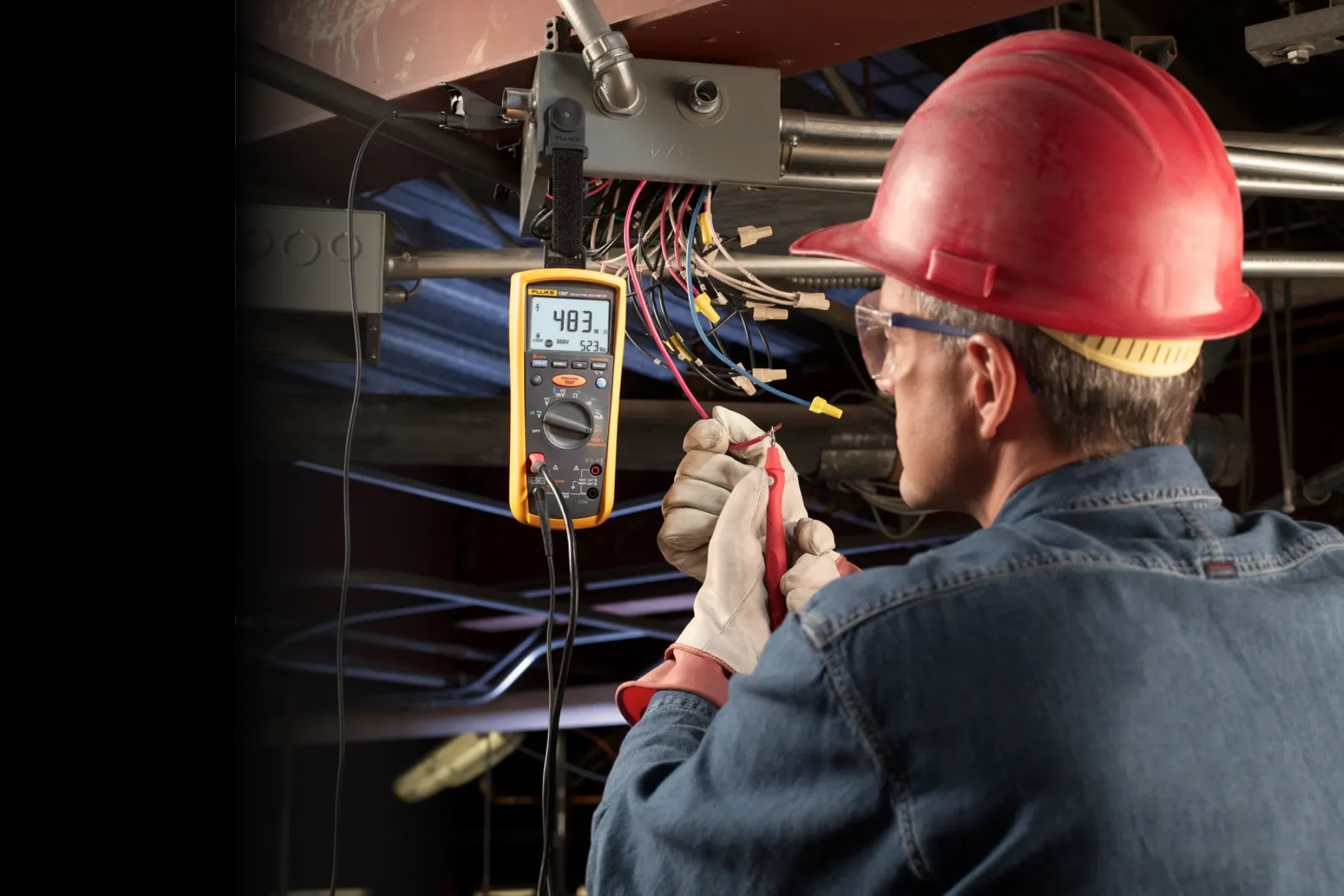
Insulation Resistance & Polarization Index Testing
Secure your electrical assets with expert Insulation Resistance Testing
Ensure the safety, reliability, and efficiency of your electrical systems with professional Insulation Resistance (IR) and Polarization Index (PI) testing services. At AssetConditionMonitoring.com, we provide advanced diagnostic solutions across the UAE and the Middle East to identify insulation weaknesses, moisture ingress, or aging before they result in costly failures.

What is Insulation Resistance (IR) Testing?
Insulation Resistance (IR) testing, also known as the Megger test, measures the resistance of electrical insulation in cables, motors, switchgear, transformers, and entire electrical networks. High resistance readings indicate healthy insulation, while low values may signal issues such as moisture, contamination, surface dirt, or material aging.
By detecting weak spots early, IR testing reduces the risk of equipment failure and enhances safety and operational reliability. Our team uses advanced tools and industry best practices to provide accurate measurements, detailed diagnostics, and professional reports for preventive maintenance and compliance.
How Insulation Resistance is Measured?
-
Test Voltage & Duration: Selected according to equipment ratings to ensure safe, precise evaluation.
-
Circuit Preparation: Equipment is de-energized and isolated for safety.
-
Measurement: Resistance is measured between live, neutral, and earth points using a DC voltage source.
-
Interpretation: Readings are compared with standard thresholds (e.g., > 1MΩ for low-voltage systems) to determine insulation health.
Environmental factors, such as humidity and temperature, can affect results. Consistent or rising readings indicate sound insulation, whereas sudden drops may signal deterioration.
Polarization Index (PI) Testing
The Polarization Index (PI) test complements IR testing by assessing insulation condition over time. It measures the ratio of insulation resistance at 10 minutes to that at 1 minute:
PI = IR at 10 minutes ÷ IR at 1 minute
-
PI > 2.0 — Good insulation
-
PI 1.0 – 2.0 — Marginal; may require maintenance
-
PI < 1.0 — Poor insulation; unsafe
The PI test reveals long-term insulation health by accounting for moisture, dirt, and insulation deterioration that may not be visible in a standard IR test. It evaluates the combined effects of:
-
Capacitive current (Ic) – insulation's charge storage ability
-
Conductive current (Ig) – leakage through insulation material
-
Surface leakage (Is) – contamination and moisture effects
-
Polarization current (Ip) – alignment of molecular dipoles under a DC field
By measuring these components, PI testing provides a clear picture of insulation reliability and helps schedule preventive maintenance effectively.
Why Choose Us?
- 19+ years of expertise in electrical testing and condition monitoring
- Certified engineers and technicians providing on-site solutions
- Standards-compliant services following IEC, IEEE, and international guidelines
- Focused on enhancing equipment life, safety, and operational efficiency
- Accurate, reliable testing for cables, motors, switchgear, and transformers
- Comprehensive reports with actionable insights for preventive maintenance
- EnFocused on enhancing equipment life, safety, and operational efficiency
Protect your assets and ensure electrical safety
Schedule your Insulation Resistance and Polarization Index testing with AssetConditionMonitoring.com today. Our experts provide accurate, reliable, and standards-compliant testing to safeguard your equipment and extend its operational life.
Frequently Asked Questions
What is the IR and PI value?
+
−
- IR (Insulation Resistance): Resistance measured between conductors and ground, indicating insulation quality.
- PI (Polarization Index): Ratio of 10-minute to 1-minute IR readings, assessing long-term insulation health.
What is an acceptable PI value?
+
−
- PI > 2.0 →Good insulation
- PI 1.0–2.0 →Marginal; may require maintenance
- PI < 1.0 → Poor insulation; unsafe
What is a good PI reading on a motor?
+
−
- Above 2.0 →Healthy insulation
- Below 2.0 →Possible moisture, dirt, or insulation deterioration
What is a good IR value?
+
−
- Low-voltage systems: >1 MOhm
- Medium/high-voltage equipment:(kV + 1) MOhm
What is the purpose of IR and PI testing?
+
−
- Evaluate insulation integrity
- Detect moisture, dirt, or aging
- Prevent electrical failures and safety hazards