
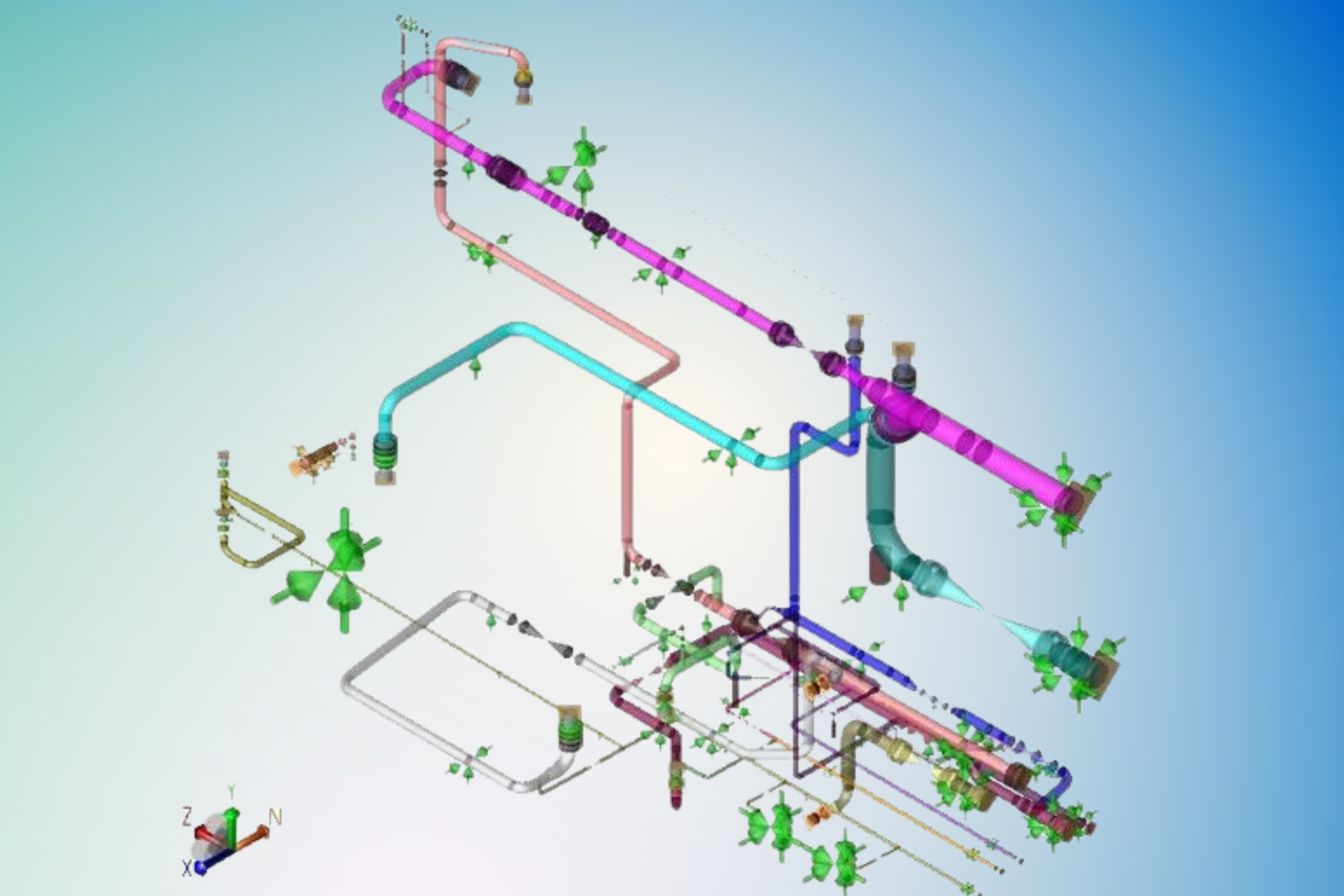
Piping Vibration Analysis
Piping vibration analysis is used to find how and why a pipe vibrates in a mechanical system, identifying the source of vibration and whether it poses a threat to the safety of piping systems. We combine non-invasive testing, such as advanced Ultrasonic technology, to pinpoint the faults.

Piping Stress and Vibration Analysis
Piping Vibration monitoring is vital in ensuring the safety and integrity of piping mechanical systems. It involves detecting vibration sources in pumps, compressors, etc, measuring vibration levels, and evaluating the severity of fatigue, noise, and the probability of failure. Extreme vibrations in pipes may cause issues such as fatigue cracks, loosening of clamps, premature wear, damage to connected equipment, and acoustic resonance.
We at assetconditionmonitoring.com provide expert services for piping stress and vibration analysis, offering precise assistance even in high-risk locations.
Why are we trusted across industries?
- Extensive experience with diverse piping systems in refineries, petrochemicals, pipeline stations, water injection units, and onshore/offshore platforms.
- Cost-effective piping evaluations, error-free vibration measurements, and ensures compliance with industrial standards.
- We employ generic tools and software to model piping, assess anomalies, and implement actionable solutions, customised to your needs, enhancing reliability.
Benefits of Piping Stress and Vibration Analysis
-
Increased safety
Prompt piping vibration analysis enhances the safety and integrity of equipment and personnel.
-
Improved uptime
Detecting and addressing vibrations early reduces downtime and improves operations and efficiency.
-
Efficient IMS
Relying on data-driven and action-oriented reports provides error-free statistics for an efficient Integrated Management System.
-
Reduced operating Risk
Piping stress and vibration analysis significantly reduces operating risk by finding vibrations early, thereby improving overall safety and efficiency.
Why Partner with our company?
As one of the leading Vibration analysis companies, assetconditionmonitoring.com, we offer the best piping stress and vibration analysis services to our clients. With proven expertise, customised services, and reliable results, we combine the most modern solutions and advanced tools to optimise your piping systems. With decades in the field, our team carefully imparts precise piping vibration solutions for high-risk zones with no compromise on safety and quality. Choose assetconditionmonitoring.com to evaluate the condition of your piping systems and ensure reliability in the long run. We provide:
- Multi-Industry Piping Expertise.
- Advanced Vibration and Stress Analysis
- Failure investigation and RCA
- Design compliance & optimization
- Custom mitigation Strategies
- 3D scanning and smart piping layouts
Frequently Asked Questions
How to measure piping vibration?
+
−
Piping vibration is measured using special tools such as an accelerometer or velocity transducer, which is mounted on the pipe surface. The sensors record vibration (acceleration, velocity, or displacement). Generally, the data is analysed in the FFT to identify frequency and amplitude.
What is the standard for piping vibration?
+
−
Several industry standards guide piping vibration assessments, including:
- Energy Institute Guidelines (EI 2008/2022) for small bore and mainline piping.
- API 618 and API 674 for reciprocating and centrifugal pumps.
- ASME B31.3 Appendix F for design-based vibration analysis.
These standards provide acceptance criteria based on vibration amplitude, frequency, and piping layout.
What is the frequency of piping vibration?
+
−
Piping vibration can occur across a wide frequency range:
- Low-frequency (0–20 Hz): Typically caused by mechanical imbalance, reciprocating machinery, or surge.
- Mid-frequency (20–200 Hz): Often associated with fluid-induced forces, acoustic excitation, or structural resonance.
- High-frequency (>500 Hz): Usually linked to acoustic-induced vibration (AIV), especially near PSV/BDV discharges.
How do you analyse vibration?
+
−
Vibration is analyzed using a combination of:
- Field measurements (accelerometers, strain gauges, pressure sensors)
- Signal processing (FFT, time waveform analysis)
- Modal and harmonic FEA (to determine natural frequencies and mode shapes)
- Simulation tools like CAESAR II, ANSYS, AFT Impulse, and AutoPIPE for dynamic response evaluations.